
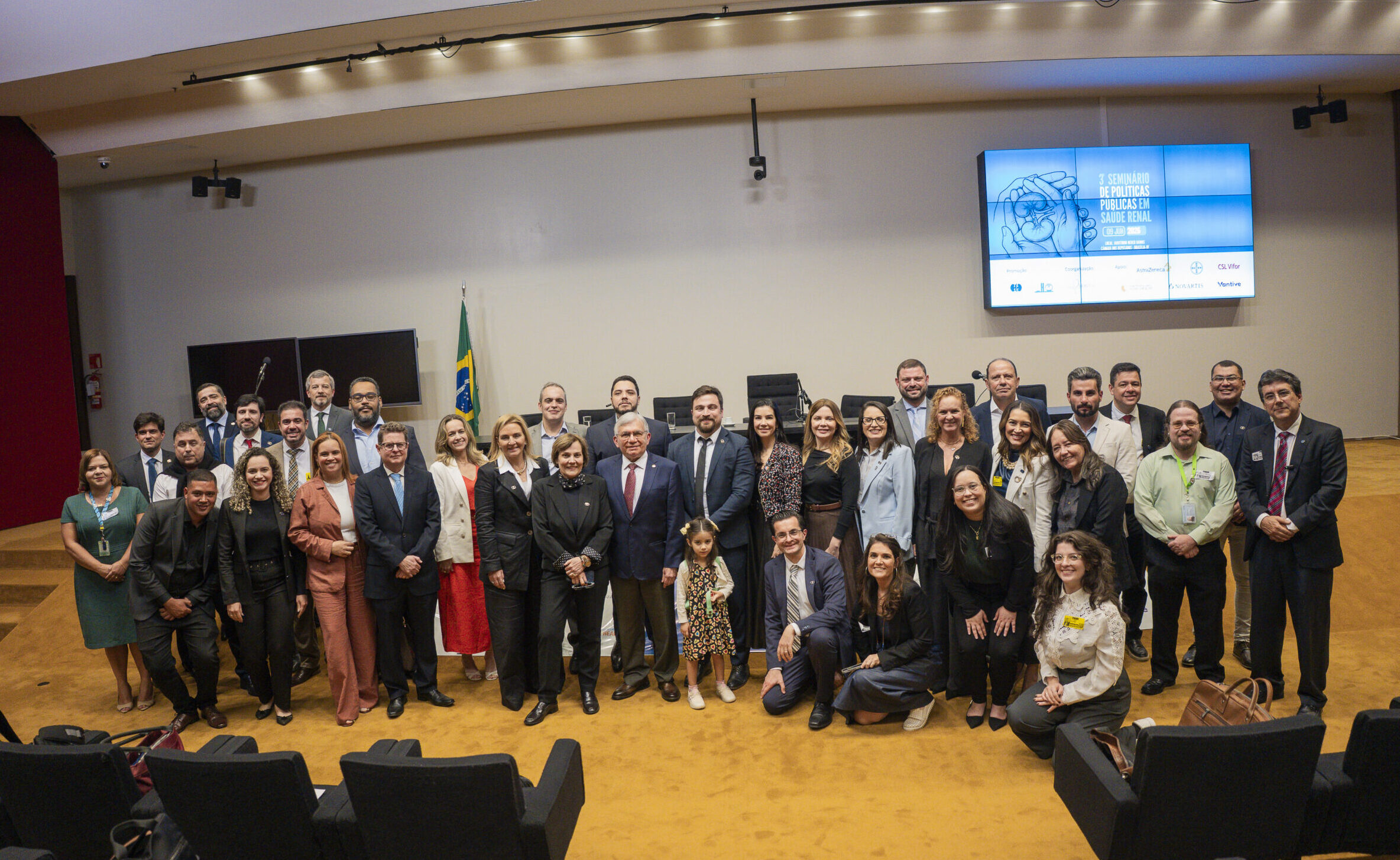
On 9 June 2026, GloPAKH joined the Brazilian Society of Nephrology (SBN), Casa Hunter and the Parliamentary Front for Nephrology to co-host a National Policy Seminar on kidney health at the Brazilian National Congress, bringing together lawmakers, government health officials, clinicians and patient advocates to discuss a new approach to kidney care in Brazil, in line with the WHO Kidney Health Resolution and the UN High-Level Meeting Political Declaration on noncommunicable diseases.
Representatives from the Ministry of Health, the Brazilian Health Regulatory Agency (ANVISA), the National Academy of Medicine and patient organizations like the National Federation of Kidney and Transplanted Patients Associations (FENAPAR) promoted an insightful discussion on how Brazil can move toward earlier detection, more equitable access, and a more sustainable model of kidney care.
Representing GloPAKH, patient advocate Allison Andrade spoke as both a kidney transplant recipient and a member of the Global Alliance, calling for two commitments from policymakers: recognizing CKD as a public health priority, and strengthening early detection and timely treatment. He emphasized that patients are not merely recipients of policy, but hold practical knowledge of where care works, where it fails, and what needs to change. That is why they should help shape it.
A central theme was the urgent need for early diagnosis. Speakers noted that CKD often progresses silently, and that catching it earlier, through stronger primary care and routine testing, can reduce hospitalizations, lower costs to the health system, and change the course of a person’s life long before dialysis or transplant become necessary.
With an estimated 20 million Brazilians affected by CKD and 184,000 currently in renal replacement therapy, participants agreed that prevention can no longer be treated as secondary to treatment. Dr. Roberto Pecoits Filho, member of GloPAKH’s Medical Advisory Council, reinforced that early diagnosis must be a fundamental pillar of kidney care, pointing to the body of science-based documents GloPAKH has produced making the case that earlier care is better for all parties involved.
Regional inequality also featured prominently. Attendees described how access to care varies dramatically across Brazil, citing transportation barriers in the North, technological gaps in the South, and educational needs in the Center-West. Several speakers pointed to the absence of public-system nephrologists in capital cities like Florianópolis as evidence that the gap between Brazil’s advanced transplant infrastructure and everyday access to basic nephrology care remains wide.
Patients with rare kidney diseases were a particular focus. Advocates highlighted that conditions like ADPKD still have no available treatment pathway in Brazil, and that specialized pediatric centers often stop care at age 14, leaving a gap for patients transitioning to adult services. Speakers stressed that the complexity of a rare diagnosis should never be a barrier to the right to care.
Ministry of Health representatives pointed to recent progress, including increased federal transfers to states for renal care, while acknowledging more is needed. Officials signaled continued commitment to reform, including a proposed 15% increase to hemodialysis reimbursement rates, expanded support for home-based peritoneal dialysis, and dedicated transport for patients undergoing renal replacement therapy.
The day closed with a shared call to action: it’s essential for all stakeholders to work together toward early diagnosis and better access. Dr. José Andrade Moura Neto, SBN’s president, emphasized that the challenges facing Brazilian kidney care remain significant, but the community is more organized, united, and ready to face them, having built bridges with patients, scientific societies, and government. Congressman Vinícius Carvalho echoed that sentiment, framing kidney health as not only a medical cause but a social one rooted in inclusion and justice, and describing the seminar as the ideal space to consolidate next steps.
Conversations between patient groups, SBN and government agencies are scheduled in the next months to discuss how Brazil can meaningfully improve kidney care through a patient-centered approach.
For GloPAKH, the Brazil seminar reflects the same momentum seen in recent national dialogues in Australia and the UK: a growing global consensus that prevention, early diagnosis, and equity must move to the center of kidney health policy.